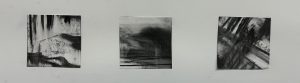
A concept I became to appreciate was the links that could be made between the different disciplines and mediums.
A broad concept of injustice prevails throughout most of the topics, some topics in more detail than others.
Artists Chair
Starting with the project about the Artists chair there are references to injustice and ineqality in Yinka Shonibare’s work. in particular the section displaying the ladder.
The wheel clamp on the chair also highlights chgallenges and discrimination experienced by the disabled, minority and ethnic groups.
Starting Points
The ‘Identity project’ was thought provoking. I was drawn to the bank of faces on the pages of the financial times. In my eyes they represented untold misery and pain at the hands of persecutors that exploit the vulnerable for personal power and/or wealth.
My artwork represented the plight of victims of abuse. A sinister outline of a man is watching the victim. The poem represents the hidden abuse that many victims suffer.
Most abuse has no consequences. More than 40 million people worldwide are affected by Modern Slavery and trafficking, and untold people are affected by domestic abuse.
Exquisite Corpses
Although there was no reference to the theme of identity in the project it did crossover with the printmaking sessions in which I produced a dry point print of the 2D Exquisite Corpse
Printmaking 2D Exquisite Corpse
I enjoyed the challenge of making a 3D version of the 2D Exquisite Corpse that I had selected. My contribution to the 2D version was the bandy legs.
I used various items that I already had at home to produce the model.
Unfortunately I did not think that 3D meant to see all around the model, and had to make some changes in the studio. Fortunately I had taken some items to carry out the modifications.
Printmaking
In the printmaking sessions I chose to make a collography plate referencing modern slavery and trafficking. The artwork is named ‘It’s closer than you think’
Photography
I decided to use the same image multiple times within one photograph. This leads the viewer to question why there are so many duplications of the same person, all identical. Although the picture shows a smiling face, which could suggest a normal happy structured life it actually represents the loss of individuality, the very thing that makes us uniquely human.
Life Drawing
Drawing in general started at the beginning of term with a personal object. As I had no drawing experience it was a very useful exercise for the life drawing class. I wasted a lot of time jumping straight in to do the sketch. I should have made a sketch or series of sketches to address perspective and proportion. I would then have realised to start in the central area of the toy.
We also did some sketched in the Imperial War Museum that were helpful towards the life drawing class.
The life drawing did not incorporate any reference to the theme of identity.
Although I had no experience of life drawing I was pleased with my efforts.
I was very please with the charcoal drawing
To assist with the projects I researched methods, contexts and other artists.
Sarah Shamma, born in Syria, lives in London. King’s artist in residence in 2019 working with the university’s institute of Psychiatry, Psychology & Neuroscience (IoPPN), and the Helen Barber foundation. Developed a new visual vocabulary of modern slavery.
Lisa Kristine, is an American humanitarian photographer, activist and speaker. Her powerful images document the pain of modern day slavery.
 katsart.uk